
- Albert Einstein
If you have ever thought about the ultimate question of Life, the Universe, and Everything, you have probably noticed such weird things as the temporal paradox, the wave-particle duality, and the Copenhagen interpretation. You may also have been puzzled by the question of why physicists cannot unify general relativity and quantum mechanics. All this has happened because quantum mechanics has gone astray, and no one wants to admit it. Although it is possible to construct a picture of the world without the strange things mentioned above, still no one gives a shift (a paradigm shift). Below, you may find a possible answer to the question of why quantum mechanics may be incomplete.
What exists?
According to the conventions of the genre, we need to try answering the following question first: “What exists?” Translated into the language of modern science, a possible answer is that only quantum fields exist, and subatomic particles are merely their emanations. It is a somewhat problematic answer, though, since, as we will see below, quantum fields are just a bunch of quirky mathematical abstractions. It is also unclear why you may encounter, for example, a cat somewhere in the street, if there are only quantum fields.
The building blocks of Reality
Edmund Husserl, along with his predecessors and followers, attempted to clarify this question a little. They found that the cats you see are merely images that capture your attention one at a time. The images evoke certain linguistic concepts in our brains, and it seems we can reduce these concepts to their constituent parts - individual whiskers, body cells, atoms, and so on to infinity. All this looks quite ephemeral. Undoubtedly, some microstructures at the very base of reality, which we currently see only through abstract field equations, are all that truly exists. Otherwise, it may appear that there is nothing else real in the Universe, and that it is not possible to gain any deep knowledge of anything other than relational knowledge, where the mechanism of relations remains unclear. For example, we define mass through the amount of action that one massive body somehow exerts on the other, and so on.
So, how then we can touch the intangible fabric of reality? Some means are offered by the guess that quantum fields may be not a good enough abstraction. What might be a good one? Currently, we do not know, and probably will never really do. But we may get a little bit further if we continue our thoughts in a less abstract fashion than quantum fields allow. Let’s imagine, that some interconnected grid of “wires” that can interact with themselves lies at the most fundamental layer of reality. Thus, all macro-objects we consider real are relational phenomena grounded in the folds of the fundamental grid. Consisting only of relations, objects appear exclusively as graphs of concepts in our minds.
To introduce definite relations, we need a grid with some definite properties, although we do not know them yet. Such an assumption will bring us to very interesting consequences. And as a nice side-effect, in such a model of the world we can resolve the temporal paradox by applying the very same question: “what exists?” to time. Do the past and the future actually exist?
As you probably know, General Relativity postulates that they indeed do, in the form of a four-dimensional spacetime manifold disguised as a Poincare group. But since General Relativity is a yet another bunch of fancy mathematical abstractions, and no one from the future has attended the famous Stephen Hawking’s time-travel party, it is reasonable to doubt this. Is there a picture of the world, where the past and the future do not exist?
Cellular Automatons
A cellular automaton is a discrete computational model that consists of a set of cells put in different states, where each cell can interact with its neighbors according to some rules. If you compare them with traditional computational units, the current state of an automaton is simultaneously the data and the instruction for the next step of a computation. It actually quite often appears in nature: the patterns on seashells or prenatal development are notable examples. Some researchers have noticed that the Universe may be such an automaton on the most basic level (Wolfram had revealed his theory several years after this post was written). Оnly the present state of affairs exists in such a model. The past is gone forever, the future is only a potential possibility.

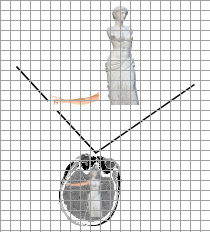
In the cellular automaton of the Universe, the past exists only in a form of the faint images of memories in an isolated part of the automaton (a skull). Humans are able to use their imagination and deductive abilities to “reconstruct” possible past or future by changing the state of their brain.
This makes the notion of time completely subjective. And such a universe also throws us into the doom of the absolute determinism. But we still do not know is there something else that can interact with it.
What quantum mechanics may actually describe?
We still do not know. Quantum mechanics uses the notion of ‘wave function’ to describe the evolution of a particle moving through a continuous absolute background space. It is implied that the value of the function is linked to the probability of the observation of that particle at the given coordinates. According to the theory, being unobserved, a particle can exist simultaneously anywhere the wave function has a value. To make waves look like particles, Copenhagen interpretation introduces something called ‘a wave function collapse’ – the ‘process’ in which ‘wave function’ collapses when someone observes or interacts with it, so the particle becomes localized. Under such assumptions, the classical reality is created from a quantum one in the moment of the observation.
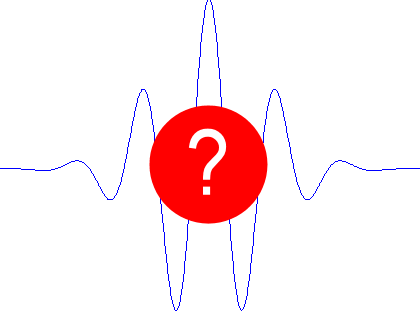
“Artist’s” representation of wave-particle duality
However, there are some glitches in such an interpretation. High-energy gamma-particles, for example, are scattering in mutual collisions “observing” each other (becoming finely localized in space), but less energetic photons do not interact and even are able to pass through thick concrete walls. The famous double-slit experiment shows us that particles of matter may act like waves (the problem of wave-particle duality). An observation strips particles of their wave-like properties. The quantum eraser experiment also tells us that an observation could be ‘undone’. All these inconsistencies in the Copenhagen interpretation may make us pose a question: are particles real at all? If not, what are the alternatives? At this point, the interconnected grid mentioned above comes very useful.
Had Michelson and Morley misinterpreted their results? Does something with wonderful properties actually fill the absolute nothingness, defining space itself? How else could energy be transferred? May particles be some kind of relational phenomena rooted in such an elusive medium? As we will see below, such a medium could not be detected as easily as the classical ether, because things are not submerged in it, but rather embedded within it. The quantum space itself may be such a medium.
Why we do not just introduce a quantum space then? There is a little problem that breaks relativity - Einstein postulated that the speed of light appears constant to any observer (although this may be a measurement artifact). In the theory of relativity, space is a subjective phenomenon, everything depends on the frame of reference of the observer. Time and space are also intricately connected. But since we consider the Universe as a cellular automaton, let’s see what an absolute background quantum space can give us.
Let’s imagine that space isn’t continuous, but discrete and consists of interconnected “wires” forming loops, so its elements are substantially larger than dimensionless points (although, “particles” may still look point-like, because their interactions may involve the atomic joints of loops depicted below) .
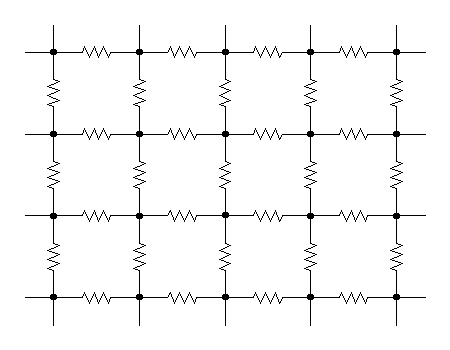
A possible structure of discrete quantum space, represented, by quantum loops. Quantum loop theory states that the loops of space actually may look not so square and may be placed in a less regular manner. In the original theory, the loops are not interpreted literally and designate the fundamental amounts and geometry of underlying atomic volumes of space itself.
This means, that in our model quantum equations actually describe not the evolution of particles, but dynamic relational structures, formed by the lattice of the quantum space. This, at least, may be true for the force-carrying particles (bosons).
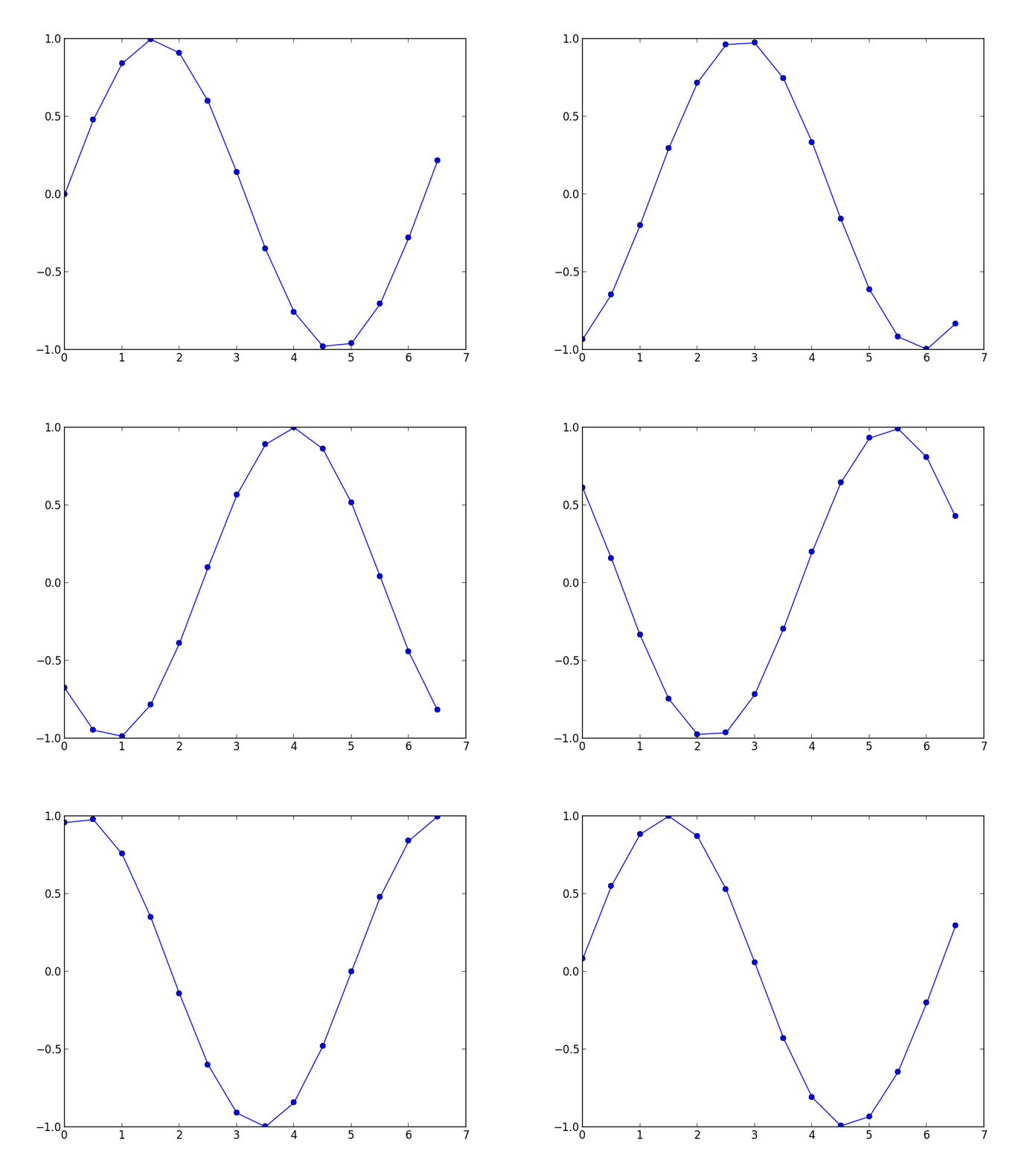
Representation of a discrete wave generated by a computer program. Note that here the elements of quantum space do not travel but only oscillate. Although, the wavefunction is considered to be a plane-wave.
In the theory, waves of light, for example, are oscillations of some abstract quantities - the vectors of magnetic and electric fields, which define a potential to act on electromagnetically-coupled particles of matter. In reality, electromagnetic waves may be rotational oscillations along a line of the lattice which then interacts with atomic joints. Photons may look like particles exactly because their oscillations concentrate along a single line of the lattice. Gravitational waves (runaway shifts in the curvature of space) may differ from electromagnetic waves by the arbitrary number of the lattice “wires” they involve.
If we unfurl our imagination to the full extent, we may find where Einstein’s differential geometry of space may come from. The particles of matter (fermions) may be yet another kind of dynamic relational structures in quantum space. In the theory fermions are defined by spinors - mathematical structures that describe rotation by 720 degrees. If we imagine such rotation in our grid, it may involve the rotation of the joints of its elements:
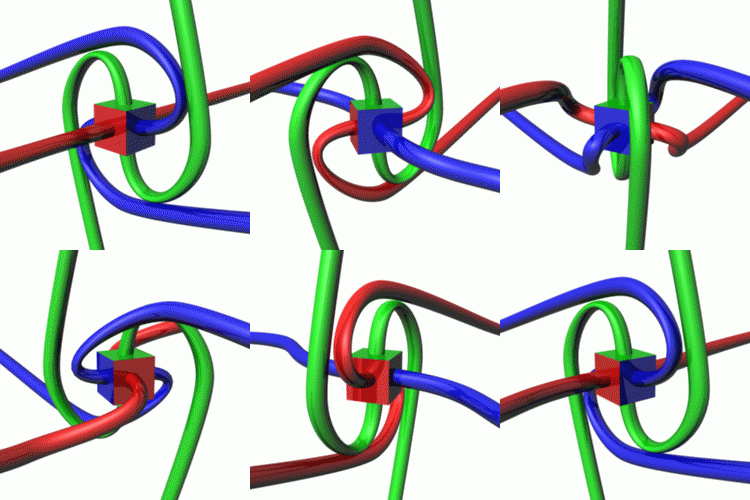
An ½-spin 3D rotating point. Imagine that potential fields, including gravity, may be the byproducts of the pull, generated by such structures. Since rotating objects have inherent inertia, this mechanism may also explain the equivalence of gravitational and inertial masses.
In reality, particles of matter may look not so simple, because there are several kinds of symmetries that govern three of the four known interaction forces, so there should be multiple levels of organization inside particles or in the structure of the quantum space itself.
In such a universe, there should be no distinction between classical and quantum reality. Classical reality does not emerge from quantum one at the moment of observation. Such reality is singular and everlasting, the observation does not create it, but may just change how it exists, from which the subjectivity still emerges.
How quantum fields work
Quantum field theory (QFT), most likely, reflects not the actual structure of reality but the way how mathematicians like to model things. Mathematicians love things they can describe with equations. They take the Klein-Gordon equation, for example, solve it and get a static set of particular solutions. Such picture barely fits to the concept of cellular automata.
QFT postulates that there are various quantum fields consisting of infinite number of harmonic oscillators. The state of an oscillator reflects the state of energy. The properties of these fields determine the behavior of particles of force and matter respectively. Matter particles have force charges, and force fields are somehow coupled with matter fields through these charges. Matter particles can exchange virtual force particles, participating in electromagnetic, weak and, strong interactions. It is thought that force particles somehow locally disturb the wave function of matter particles, so matter particles, for example, change their direction.
There is no place for gravity in such a quantum system of the world, and no one knows why. But now you may have a glimpse - being modeled as the dynamic relational structures, particles of matter may create a gradient in the geometry of the lattice of quantum space, so any other things embedded into it will naturally follow the curvature, which creates visibility of an acting gravitational force (in Einstein’s theory the most of the apparent force is created by time dilation). No virtual particles are involved.
The twistor theory of Roger Penrose is the example of a theory that models gravitational dynamics in the spirit of quantum fields. But if you want to seriously approach the great unification using the picture of the world described here, you need to offer a way how different forces emerge in the universal lattice of quantum space, and why and when they interact with matter and between themselves.
There may be no unified field theory
Einstein’s final dream, the unified field theory, may actually be unreachable, since in such a universe we have a limited number of ways that things can interact, and they seemingly differ. Because there are no particles per se in our imaginary universe, there are two other obvious mechanisms by which gravitational and electromagnetic fields may actually work:
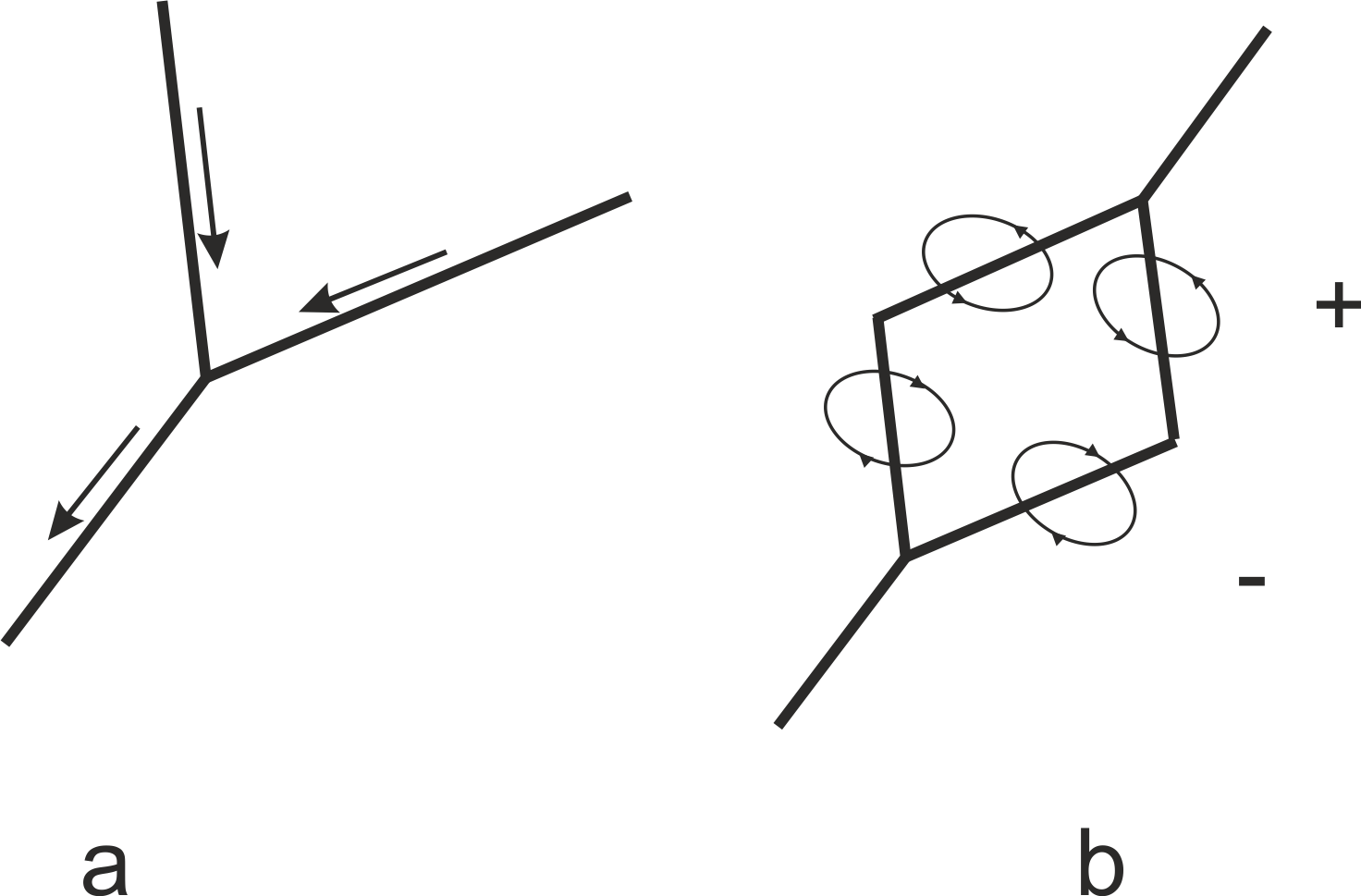
a) - gravitational gradient (pull) which makes space appear curved at large scales; b) - electromagnetic field may be propagated through rotational gradient (or rotational waves which comprise virtual force particles) of quantum space fibers created by the spin of a rotating particle.
And what is for cats?
There is also a couple of questions we just can not pass by. What should happen to Schrödinger’s cat in such a world?
Schrödinger’s question actually asks where lies the boundary that separates quantum and classical worlds, or at which scale a superposition of quantum states is possible? And most notably, why an observation breaks the superposition? Since in our model quantum equations describe not particles (or waves), but dynamic relational structures, the problem of observation disappears. The cat is dead or alive, nothing in between. No concept of observation is ever necessary, the microscopic states just influence each other at the intersections of the grid, appearing as particles. But we can only know the statistical outcomes of their interactions since there is not enough observable initial data about the grid to put into our incomplete equations.
Although, the problem of the borderline still remains. It is obvious, that quantum states that are subjects of existing superposition should be elementary enough in the terms of the quantum lattice described above. It is pretty hard to formalize where the borderline should lie exactly. Probably, there is no well-defined border, since even quite complex molecules are known to produce interference patterns.
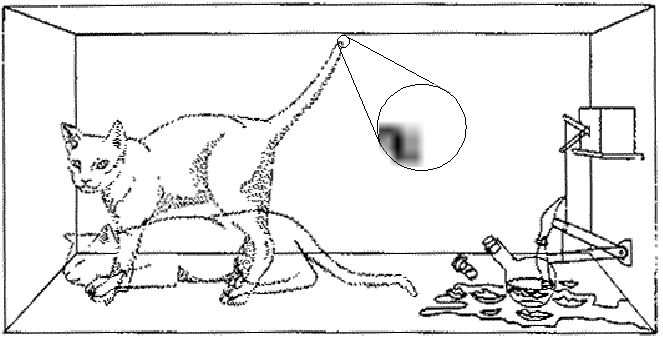
If we look at Schrodinger’s cat from the outside of our imaginary Universe at a scale comparable with the dimension of the space elements, we will see that it looks like a fuzzy weaving ( which de Broglie probably foresaw) in the rippling fabric of quantum space. But it could be dead or alive only on the macro scale.
What we can say about quantum entanglement and its nonlocality? We can imagine anything that does not contradict observations. If there is no superdeterminism, let’s assume, that to some extent, the quantum lattice is able to keep a history of what happens in it. Its different regions may instantly influence each other through this history as, for example, a sequence of gears will do. But in reality, this interconnection may emerge from something more profound.
And there is a question we can not answer. In the terms of energy transfer, if energy is the state of the cosmic lattice, it is still hard to imagine how the wave function of a single photon could be split, which seems to actually happen in the experiments.
The retirement of quantum fields and the introduction of quantum lattice allows us to obtain a picture of the world, which seems a little bit saner than the generally accepted one. That is the power of uncritical rationalism.
Why does nobody seem to care?
Why does everyone tend to consider Einstein’s picture of the world plagued with paradoxes and artificial constructs as a good enough approximation of reality? Because his theory achieves perfect correspondence with measurements. Such is the instrumentalist approach to science.
Scientific theories only die along with their apologists as Max Planck had once noticed in a letter to Albert Einstein. The theories of special/general relativity are the main hindrances here. Their nearly religious status hinders everyone to see that they are no less bizarre than the most exotic interpretations of quantum mechanics.
As it is known, there is no experiment (except, of course, the rotating bucket with some reservations) that can allow distinguishing between a still and an inertially moving frame of reference. In spite of that, Einstein decided to throw out Newton’s absolute space and time, by offering the postulates of his own theory. But the current practical impossibility to discover the background space does not automatically imply that the background space required by the quantum theory does not exist. Ironically, Einstein himself eventually has realized the implications his postulates may bring.
What could have happened, if quantum mechanics wasn’t led by the presumably quite unreal way of particles and observations? Only Heisenberg might know this (probably). Somewhere in there, there is probably a Nobel Prize or two waiting to be found.